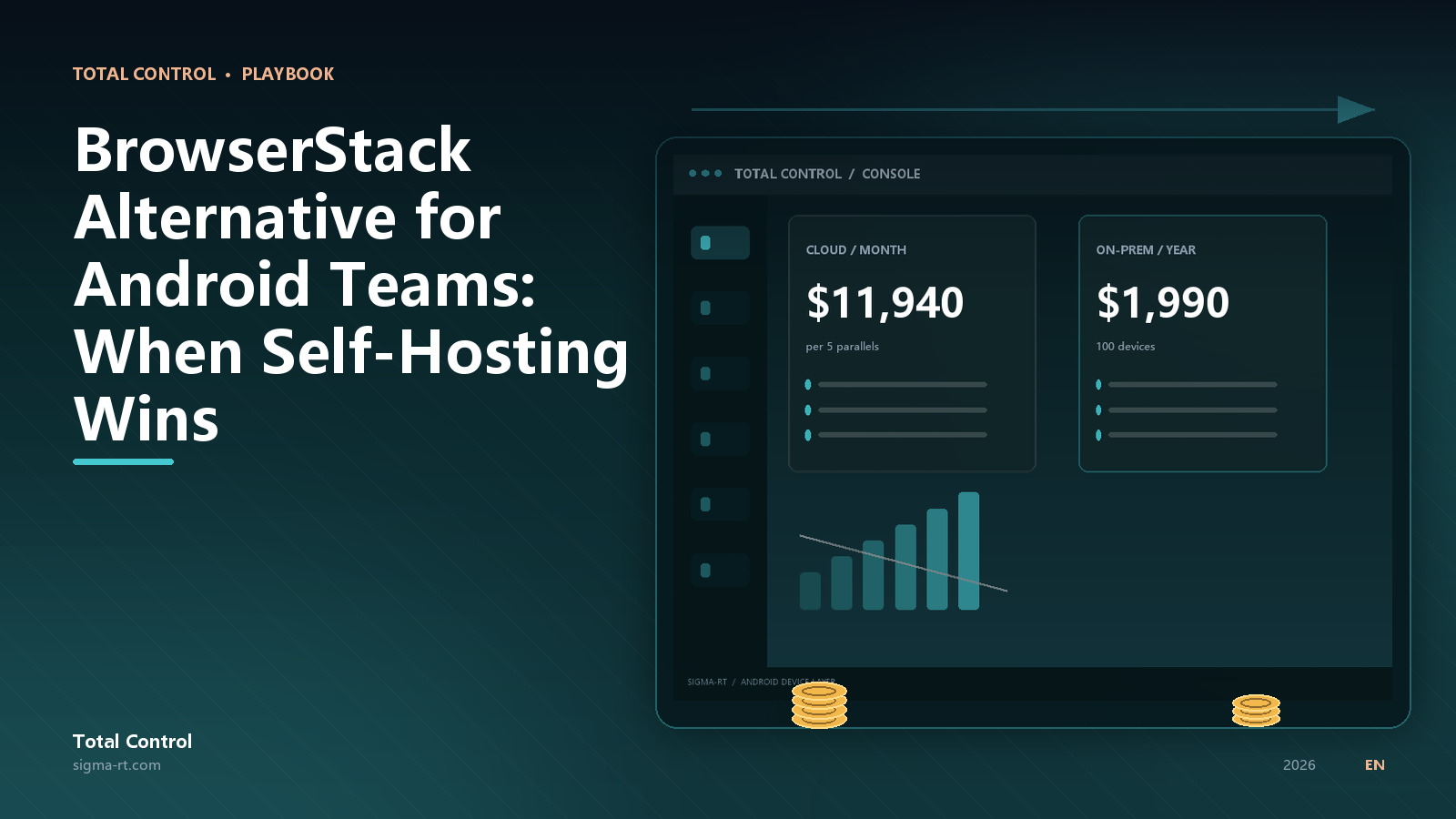
BrowserStack Alternative for Android Teams: When Self-Hosting Wins
The renewal email is where most BrowserStack alternatives get considered. A team starts with two parallel sessions, adds three more for regression, and two years later the Android device bill is larger than the cost of the phones in the drawer.
This is not an argument that BrowserStack is bad. It is an argument that BrowserStack is a managed global device cloud, and not every team needs one. If most of your Android regression runs on 20–50 devices you already own, a self-hosted lab can cut the per-session meter without giving up automation.
Here is a decision framework, a cost comparison, and a migration plan that does not require rewriting your tests.
First, separate what you are paying for
BrowserStack bundles several things:
- a catalog of 10,000–35,000+ real devices;
- managed infrastructure, so nobody plugs in phones;
- iOS and Android;
- CI integrations, reports, tunnels and support;
- a per-parallel-session pricing model.
If you need the catalog, the managed infrastructure, or iOS, that bundle is worth paying for. If you mainly need parallel Android regression on devices you own, you are paying for a lot of bundle you do not use.
Cost comparison
|
Total Control |
BrowserStack App Automate |
LambdaTest |
Sauce Labs |
|
|---|---|---|---|---|
|
Pricing anchor |
$1,990/year for 100 devices |
$199 per parallel / month (list) |
$15–199 per parallel / month |
$199–249 per parallel / month |
|
5 parallel Android sessions / year |
$199 (10 devices) – $1,990 (100 devices) |
~$11,940 |
~$900–11,940 |
~$11,940–14,940 |
|
Data location |
Your network |
Vendor cloud |
Vendor cloud |
Vendor cloud |
|
iOS |
No |
Yes |
Yes |
Yes |
|
Managed infrastructure |
No |
Yes |
Yes |
Yes |
|
Per-minute meter |
No |
Session-based |
Session-based |
Session-based |
The list-price comparison is dramatic, but be fair: cloud vendors discount at renewal, and your quote may be 30–40% below list. The point is not that TC is always cheaper. The point is that the pricing model is different: fixed annual per device versus per parallel session.
When you should stay on BrowserStack
Be honest about these:
- You need iOS. TC is Android-only.
- You need a huge device catalog. If your coverage matrix includes 100+ models you do not own, a managed catalog is cheaper than buying them.
- You have no infrastructure appetite. A self-hosted lab needs a powered hub, a Windows PC and someone to own device health.
- Your volume is low. A few hours of testing a week will not justify the hardware and maintenance.
If three or more of these apply, renew BrowserStack and negotiate hard.
When self-hosting wins
- Daily Android regression on 20+ owned devices. The per-session meter dominates the testing budget.
- Regulated data. Fintech, healthcare, automotive and government teams that cannot send builds and logs to a third-party cloud.
- Device-specific products. Kiosks, POS, scanners, head units and custom Android hardware that cloud catalogs do not carry.
- Cost-sensitive scale-ups. Teams that need 50+ Android devices but cannot justify a five-figure cloud contract.
The migration path
Do not rip out your test framework. Replace the device layer.
Step 1 — pick one suite. Choose the Android regression suite with the highest cloud spend. Run it on 10–20 owned devices with Total Control. Keep the same assertions and reporting.
Step 2 — wire CI. Call the TC REST API from Jenkins, GitHub Actions or GitLab CI. Install the build, start the run, pull screenshots and logs.
Step 3 — move the long tail. Migrate device-specific and old-Android coverage first. That is where cloud catalogs are weakest and your owned devices are strongest.
Step 4 — keep a hybrid. Many teams keep BrowserStack for iOS and broad device coverage, and use TC for daily Android regression. That is a perfectly rational outcome.
What TC replaces — and what it does not
TC replaces the device layer: connecting, controlling, naming, grouping and automating Android devices on your network. It gives you a multi-device grid, element-level automation (AAI/FindNode), JavaScript and REST APIs, and on-prem execution.
It does not replace:
- a managed global device catalog;
- iOS testing;
- a test management or reporting platform;
- a cloud tunnel for testing staging environments from anywhere.
Be clear about that in the procurement conversation. Overselling TC as “BrowserStack but cheaper” leads to the wrong evaluation. The right framing is: keep the cloud for breadth; self-host the Android devices you already own for depth and volume.
FAQ
Can I run both? Yes, and most teams should. Use BrowserStack for iOS and rare devices; use TC for daily Android regression.
How long does migration take? One suite in 1–2 weeks, including CI wiring. Expanding device coverage is incremental.
What about reports? TC returns screenshots and logs; keep your existing test reporter. It is a device layer, not a replacement for your reporting stack.
Is there a per-minute fee? No. TC is licensed by device count for a year.
If you want to compare your actual renewal quote with a 100-device self-hosted lab, see TC pricing or read the BrowserStack alternative landing page.